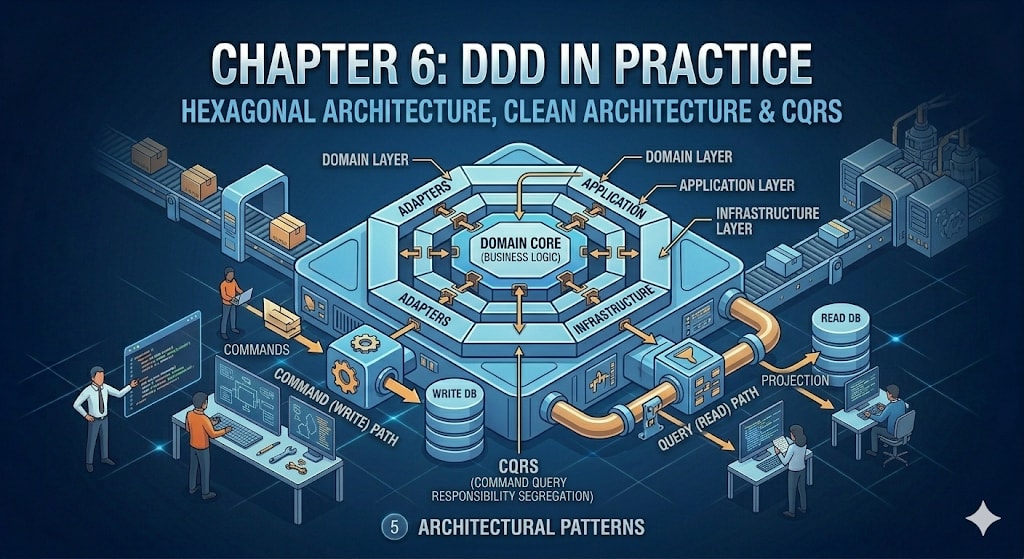
Chapter 6
DDD in Practice — Hexagonal Architecture, Clean Architecture & CQRS
I. DDD Without Architecture is Half the Job
The previous chapters built the domain model: Entities, Value Objects, Aggregates, Domain Services, Repositories, Domain Events. But a model alone doesn't tell you how to structure your project files, which layer depends on which, or how to keep infrastructure from leaking into domain logic.
Architecture patterns answer these questions. Three have become the standard companions to DDD:
- Hexagonal Architecture (Ports & Adapters) — isolates the domain from infrastructure
- Clean Architecture — adds explicit layer separation and dependency rules
- CQRS (Command Query Responsibility Segregation) — separates reads from writes for scalability and clarity
None of these are required by DDD. But each solves a real problem that DDD-based systems frequently encounter.
II. Hexagonal Architecture — The Domain at the Center
Introduced by Alistair Cockburn, Hexagonal Architecture (also called Ports & Adapters) places the application core — the domain — at the center, surrounded by ports (interfaces) and adapters (implementations).
                ┌─────────────────────────────────────────┐
  HTTP Request  │              Adapters                   │
  ─────────────▶│  ┌──────────────────────────────────┐  │
  CLI Command   │  │         Application Core         │  │
  ─────────────▶│  │  ┌──────────────────────────┐   │  │
  Message Queue │  │  │    Domain Model          │   │  │
  ─────────────▶│  │  │  Entities, Aggregates,   │   │  │
                │  │  │  Value Objects, Services │   │  │
                │  │  └──────────────────────────┘  │  │
                │  │  Application Services           │  │
                │  │  (Ports defined here)           │  │
                │  └──────────────────────────────────┘  │
                │  Adapters: DB, Email, HTTP clients      │
                └─────────────────────────────────────────┘
Ports — The Contracts
Ports are interfaces defined by the application core. There are two types:
Driving Ports (inbound): How the outside world interacts with the application.
// Primary / driving port — defined in the application layer
interface OrderApplicationService {
  placeOrder(command: PlaceOrderCommand): Promise<OrderId>;
  confirmOrder(command: ConfirmOrderCommand): Promise<void>;
  cancelOrder(command: CancelOrderCommand): Promise<void>;
}
Driven Ports (outbound): What the application needs from the outside world.
// Secondary / driven ports — defined in domain/application layer
interface OrderRepository {
  findById(id: OrderId): Promise<Order | null>;
  save(order: Order): Promise<void>;
}

interface PaymentGateway {
  charge(request: PaymentRequest): Promise<PaymentResult>;
}

interface EmailNotifier {
  sendOrderConfirmation(to: Email, orderId: OrderId): Promise<void>;
}
Adapters — The Implementations
Adapters implement ports using concrete technology. They live in the outermost layer and depend inward.
// HTTP Adapter (driving)
@Controller('/orders')
class OrderController {
  constructor(private readonly service: OrderApplicationService) {}

  @Post('/')
  async placeOrder(@Body() body: PlaceOrderRequest): Promise<{ orderId: string }> {
    const orderId = await this.service.placeOrder(
      new PlaceOrderCommand(body.customerId, body.items, body.shippingAddress)
    );
    return { orderId: orderId.value };
  }
}

// PostgreSQL Adapter (driven)
class PostgresOrderRepository implements OrderRepository {
  async findById(id: OrderId): Promise<Order | null> {
    const row = await this.db.query('SELECT * FROM orders WHERE id = $1', [id.value]);
    return row ? this.toDomain(row) : null;
  }
  async save(order: Order): Promise<void> { /* ... */ }
}

// Stripe Adapter (driven)
class StripePaymentGateway implements PaymentGateway {
  async charge(request: PaymentRequest): Promise<PaymentResult> {
    const charge = await stripe.charges.create({ /* ... */ });
    return this.toDomain(charge);
  }
}
Why This Matters for Testing
With Hexagonal Architecture, you can test the entire domain and application layer without starting a database or HTTP server:
// Test with in-memory adapters — fast, no infrastructure
describe('PlaceOrderService', () => {
  let service: OrderApplicationServiceImpl;
  let orderRepo: InMemoryOrderRepository;
  let paymentGateway: MockPaymentGateway;

  beforeEach(() => {
    orderRepo = new InMemoryOrderRepository();
    paymentGateway = new MockPaymentGateway();
    service = new OrderApplicationServiceImpl(orderRepo, paymentGateway);
  });

  it('should create an order with correct total', async () => {
    const orderId = await service.placeOrder(/* command */);
    const order = await orderRepo.findById(orderId);
    expect(order?.total()).toEqual(Money.of(99.99, 'USD'));
  });
});
III. Clean Architecture — Adding Explicit Layers
Robert C. Martin's Clean Architecture formalizes Hexagonal's concepts into four explicit concentric layers with a single rule: dependencies only point inward.
         ┌─────────────────────────────────────────┐
         │         Frameworks & Drivers            │  ← Outermost: Express, NestJS,
         │  ┌───────────────────────────────────┐  │              PostgreSQL driver
         │  │      Interface Adapters           │  │  ← Controllers, Presenters,
         │  │  ┌─────────────────────────────┐  │  │    Repository Implementations
         │  │  │    Application Layer        │  │  │  ← Use Cases, Application Services
         │  │  │  ┌───────────────────────┐  │  │  │
         │  │  │  │   Domain Layer        │  │  │  │  ← Innermost: Entities, VOs,
         │  │  │  │  (Entities, VOs,      │  │  │  │    Aggregates, Domain Services
         │  │  │  │   Aggregates)         │  │  │  │
         │  │  │  └───────────────────────┘  │  │  │
         │  │  └─────────────────────────────┘  │  │
         │  └───────────────────────────────────┘  │
         └─────────────────────────────────────────┘

         Dependencies: Outer → Inner (never Inner → Outer)
The Dependency Rule
The domain layer knows nothing about the application layer. The application layer knows nothing about HTTP or databases. This means:
// ✅ Domain layer — zero imports from outer layers
class Order {
  // No framework imports. No database drivers. No HTTP libraries.
  // Just pure TypeScript/business logic.
  confirm(): void { /* ... */ }
}

// ✅ Application layer — knows domain, defines ports, no concrete infrastructure
class ConfirmOrderHandler {
  constructor(
    private readonly orders: OrderRepository, // interface, not postgres implementation
    private readonly publisher: DomainEventPublisher // interface, not kafka
  ) {}
  async handle(command: ConfirmOrderCommand): Promise<void> { /* ... */ }
}

// ✅ Infrastructure layer — implements ports, depends on domain + framework
class KafkaDomainEventPublisher implements DomainEventPublisher {
  async publishAll(events: DomainEvent[]): Promise<void> {
    // Uses Kafka — outer layer knows about Kafka, inner layers do not
  }
}
IV. Project Structure
The architecture maps to a clear folder structure:
src/
├── domain/                         # Inner layer — pure domain
│   ├── order/
│   │   ├── Order.ts                # Aggregate root
│   │   ├── OrderLine.ts            # Child entity
│   │   ├── OrderStatus.ts          # Value object
│   │   ├── OrderRepository.ts      # Port (interface)
│   │   └── events/
│   │       ├── OrderConfirmed.ts   # Domain event
│   │       └── OrderCancelled.ts
│   └── shared/
│       ├── Money.ts                # Shared value object
│       └── DomainEvent.ts
│
├── application/                    # Application layer — use cases
│   ├── order/
│   │   ├── PlaceOrderHandler.ts    # Application service / command handler
│   │   ├── ConfirmOrderHandler.ts
│   │   └── GetOrderQueryHandler.ts # Query handler
│   └── shared/
│       └── DomainEventPublisher.ts # Port (interface)
│
├── infrastructure/                 # Outer layer — concrete implementations
│   ├── persistence/
│   │   └── PostgresOrderRepository.ts
│   ├── messaging/
│   │   └── KafkaEventPublisher.ts
│   ├── payment/
│   │   └── StripePaymentGateway.ts
│   └── http/
│       └── OrderController.ts
│
└── main.ts                         # Composition root — wires everything together
V. CQRS — Separating Reads from Writes
Command Query Responsibility Segregation separates your system into two sides:
- Command side: Handles state-changing operations (Place Order, Confirm Order, Cancel Order). Uses the full DDD model.
- Query side: Handles read operations (Get Order, List Orders). Uses optimized read models.
Why CQRS with DDD?
DDD Aggregates are optimized for consistency and business rules — not for query performance. An Order Aggregate enforces invariants across its lines, discount, and status. But a "list all orders with customer name and total" query doesn't need any of that — it just needs flat, denormalized data, fast.
CQRS lets you have both:
Commands → Domain Model (Aggregates, Events) → Write Database
Queries  → Read Model (Projections, Views)   → Read Database (optimized)
Command Side (Write)
// Commands are value objects describing intent
class PlaceOrderCommand {
  constructor(
    public readonly customerId: string,
    public readonly items: OrderItemInput[],
    public readonly shippingAddress: AddressInput
  ) {}
}

// Command Handler executes against domain model
class PlaceOrderHandler {
  async handle(command: PlaceOrderCommand): Promise<OrderId> {
    const customer = await this.customers.findById(CustomerId.from(command.customerId));
    const order = Order.create(OrderId.generate(), customer.id, /* ... */);
    // ... add lines, validate, etc.
    order.place();
    await this.orders.save(order);
    await this.publisher.publishAll(order.pullDomainEvents());
    return order.id;
  }
}
Query Side (Read)
// Read model — flat, optimized for the UI
interface OrderSummary {
  orderId: string;
  customerName: string;
  customerEmail: string;
  status: string;
  totalAmount: number;
  currency: string;
  itemCount: number;
  placedAt: string;
}

// Query handler — bypasses the domain model entirely
class GetOrderSummaryHandler {
  async handle(query: GetOrderQuery): Promise<OrderSummary | null> {
    // Direct SQL query against a read-optimized view or table
    return this.db.queryOne<OrderSummary>(
      `SELECT
         o.id as "orderId",
         c.name as "customerName",
         c.email as "customerEmail",
         o.status,
         o.total_amount as "totalAmount",
         o.currency,
         COUNT(ol.id) as "itemCount",
         o.placed_at as "placedAt"
       FROM orders o
       JOIN customers c ON c.id = o.customer_id
       LEFT JOIN order_lines ol ON ol.order_id = o.id
       WHERE o.id = $1
       GROUP BY o.id, c.name, c.email`,
      [query.orderId]
    );
  }
}
Projections — Keeping Read Models Current
When the write side publishes a OrderConfirmed event, a projection updates the read model:
class OrderReadModelProjector {
  async onOrderConfirmed(event: OrderConfirmed): Promise<void> {
    await this.db.execute(
      `UPDATE order_summaries
       SET status = 'CONFIRMED', confirmed_at = $2
       WHERE order_id = $1`,
      [event.orderId.value, event.occurredOn]
    );
  }
}
VI. Putting It All Together — The Full Picture
Here is the complete data flow for a "Place Order" command in a full DDD + Hexagonal + CQRS system:
HTTP POST /orders
    │
    ▼
OrderController (Adapter / Driving)
    │  maps HTTP request → PlaceOrderCommand
    ▼
PlaceOrderHandler (Application Layer)
    │  1. Load Customer from CustomerRepository
    │  2. Create Order aggregate
    │  3. Add OrderLines via domain logic
    │  4. Call PricingService (domain service)
    │  5. Call order.place() — raises OrderPlaced event
    │  6. Save Order to OrderRepository
    │  7. Pull and publish domain events
    ▼
PostgresOrderRepository (Adapter / Driven)
    │  persists Order aggregate to DB
    ▼
KafkaEventPublisher (Adapter / Driven)
    │  publishes OrderPlaced to Kafka topic
    ▼
OrderReadModelProjector (Consumer)
    │  updates order_summaries read table
    ▼
InventoryReservationConsumer (Different Bounded Context)
    │  subscribes to orders.placed topic
    │  reserves inventory asynchronously
VII. When to Use Each Pattern
| Pattern | Use When |
|---|---|
| Hexagonal Architecture | Always — it's the foundation for testable DDD |
| Clean Architecture | When you want explicit layer contracts enforced at the folder level |
| CQRS (simple) | When read and write models have clearly different shapes |
| CQRS + Event Sourcing | When you need full audit trail or temporal queries |
Start simple: You can apply Hexagonal Architecture and DDD tactical patterns without CQRS. Add CQRS when your read and write needs diverge significantly.
VIII. The Architecture at a Glance
┌─────────────────────────────────────────────────────────────┐
│  Domain Layer (innermost)                                   │
│  Entities · Value Objects · Aggregates · Domain Services    │
│  Domain Events · Repository Interfaces                      │
├─────────────────────────────────────────────────────────────┤
│  Application Layer                                          │
│  Command Handlers · Query Handlers · Application Services   │
│  Port Interfaces (secondary)                                │
├─────────────────────────────────────────────────────────────┤
│  Infrastructure Layer (outermost)                           │
│  Controllers (HTTP/gRPC/CLI) · Repository Implementations   │
│  Event Publishers · External Service Adapters               │
└─────────────────────────────────────────────────────────────┘

Dependency rule: outer layers depend on inner layers. Never reverse.
IX. Summary
| Architecture | Problem it Solves |
|---|---|
| Hexagonal | Keeps infrastructure out of the domain; enables swappable adapters |
| Clean Architecture | Explicit layer boundaries with enforced dependency direction |
| CQRS | Read and write models optimized independently; better scalability |
| Together | Testable, evolvable, infrastructure-agnostic domain model |
The pattern is consistent across all three: put the domain at the center, push infrastructure to the edges, and let interfaces define the contracts between layers.
Further Reading
- DDD, Hexagonal, Onion, Clean, CQRS — How I Put It All Together — Herberto Graça
- Domain-Driven Design and Hexagonal Architecture in Java — Vaadin
- Domain-Driven Hexagon — GitHub (Sairyss) — Full reference implementation with examples
- Hexagonal Architecture, DDD, and Spring — Baeldung
You have completed the Domain-Driven Design series. The next step: pick a real bounded context in a system you know, model it with these patterns, and let the domain drive the design.