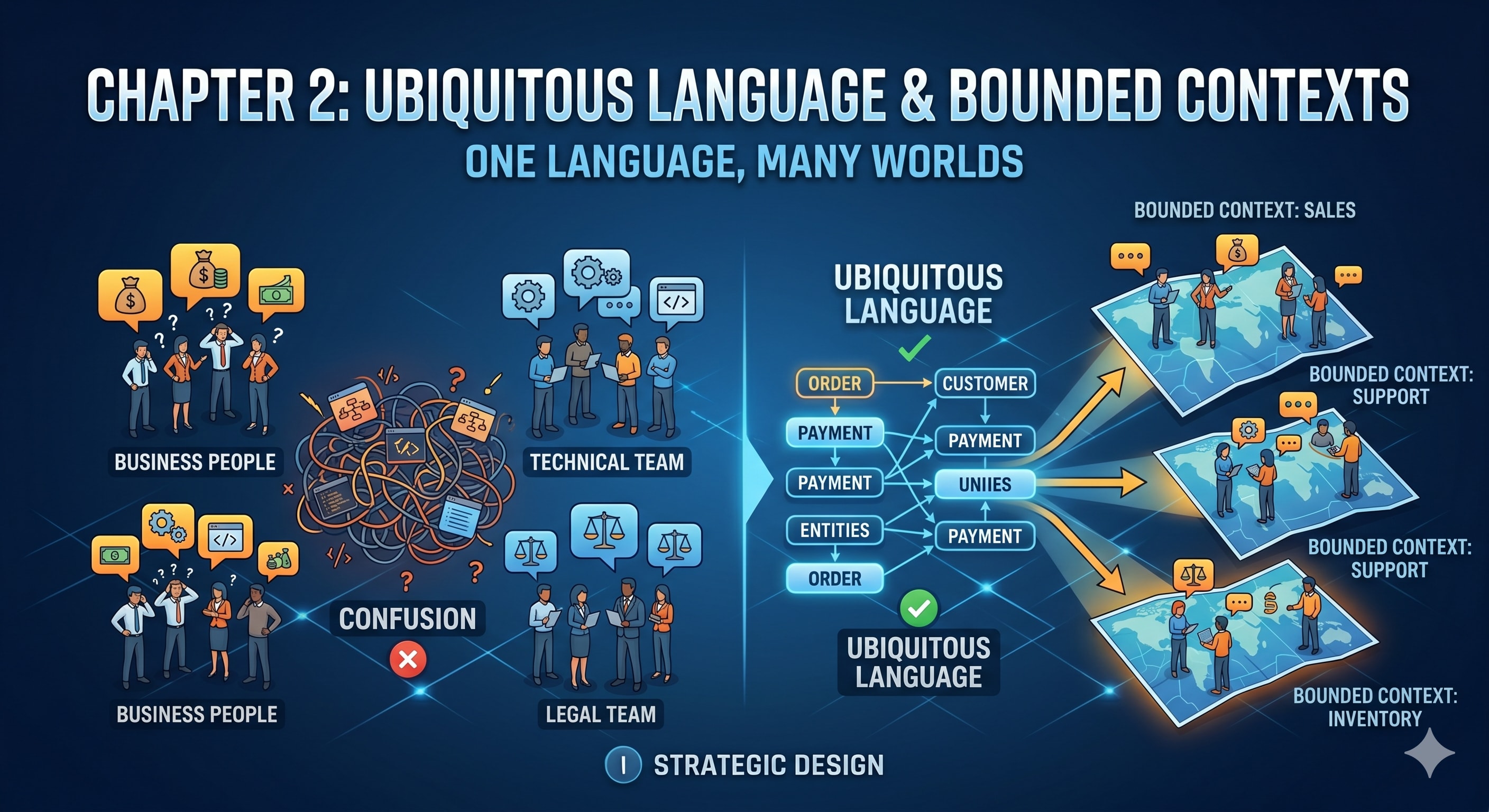
Chapter 2
Ubiquitous Language & Bounded Contexts — One Language, Many Worlds
I. The Cost of Translation
Every time a business requirement passes through a person, something gets lost or transformed. A product manager says "a Customer placed an Order." An analyst writes a requirements document. A developer reads it and creates a User table, an OrderRequest model, and a PurchaseTransaction entity.
Three weeks later, the PM asks why the system doesn't handle the case where a "Guest Customer" can place an order. The developer doesn't know what a "Guest Customer" is — because they built User, not Customer.
This is the translation tax: the cost of misalignment between how the business thinks and how the code is structured.
Ubiquitous Language is DDD's solution. Bounded Contexts are where that solution lives.
II. Ubiquitous Language — When the Code Speaks Business
The Ubiquitous Language (UL) is a shared, precise vocabulary developed collaboratively between domain experts and developers, used consistently in all communication: conversations, documentation, and — crucially — the code itself.
"Ubiquitous" means found everywhere. The same words appear in:
- Whiteboard discussions
- User stories and tickets
- Class and method names
- Database schema
- API endpoints and response shapes
- Test descriptions
What It Looks Like in Practice
Without Ubiquitous Language:
// Code                    vs.    Business says
class UserRecord {}         →     "Customer"
createPurchaseTransaction() →     "place an order"
PaymentJob.run()            →     "process payment"
getTxnHistory()             →     "view order history"
With Ubiquitous Language:
class Customer {}
customer.placeOrder(cart: ShoppingCart): Order
order.processPayment(method: PaymentMethod): PaymentConfirmation
customer.orderHistory(): Order[]
The code now reads like a business conversation. A domain expert can look at customer.placeOrder() and confirm — or correct — the model.
How to Build It
The UL is never declared; it's discovered and refined through ongoing collaboration:
- Event Storming workshops — Map domain events on a timeline with domain experts
- Glossary development — Write down terms with precise definitions that everyone agrees on
- Challenge inconsistencies — If two people use the same word differently, that's a signal, not noise
- Update the code — Every time the language evolves, refactor the code to match
"If the model doesn't reflect the domain experts' language, find the model that does." — Eric Evans
Signals That Your UL is Breaking Down
- Developers rename domain terms in code ("we call it
ProductItembut business calls itSKU") - Meeting notes use different words than the codebase
- New team members need a "translation guide" to understand the code
- Domain experts can't read test descriptions
III. Bounded Contexts — Where the Language Lives
Here is a problem: in a large e-commerce platform, the word "Product" means different things to different teams.
| Team | What "Product" means |
|---|---|
| Catalog team | A displayable item with images, descriptions, SEO metadata |
| Inventory team | A SKU with stock levels and warehouse location |
| Billing team | A line item with price, tax code, and discount rules |
| Shipping team | A physical package with weight, dimensions, and fragility |
Trying to build a single Product class that satisfies all four teams is a recipe for a bloated, contradictory model that serves no team well.
A Bounded Context is the explicit boundary within which a particular domain model — and its Ubiquitous Language — is valid and consistent.
┌────────────────────────┐    ┌────────────────────────┐
│   Catalog Context      │    │   Inventory Context    │
│                        │    │                        │
│  Product:              │    │  Product (SKU):        │
│  - name                │    │  - skuCode             │
│  - description         │    │  - stockLevel          │
│  - images              │    │  - warehouseLocation   │
│  - seoTags             │    │  - reorderThreshold    │
└────────────────────────┘    └────────────────────────┘
Same real-world thing ("Product"). Two completely different models. Both correct — within their own boundary.
The Key Insight
Bounded Contexts liberate you from the tyranny of the single unified model. You don't have to resolve the contradiction between what "Product" means to Catalog vs. Inventory. You acknowledge the difference, draw a line, and model each side independently.
Martin Fowler puts it well:
"Bounded Contexts allow DDD to avoid the need for a single model for the entire enterprise, which is hard to maintain and often leads to conflicts."
IV. Identifying Bounded Context Boundaries
This is where DDD gets difficult — and interesting. There is no algorithm for finding bounded contexts. It requires judgment. But there are clear signals:
Signal 1: Language Changes
When the same word means something different in two conversations, you likely have two contexts. A "Customer" who hasn't yet purchased is very different from a "Customer" in the billing system who has a payment history.
Signal 2: Different Rates of Change
The Catalog changes when marketing updates product descriptions. Inventory changes when items ship. If two areas of the system change independently for independent reasons, they likely belong in separate contexts.
Signal 3: Different Team Ownership
Conway's Law is real: your system architecture will mirror your team structure. If two teams own different parts of the system, those parts should have clean boundaries.
Signal 4: Different Data Consistency Needs
The Catalog can tolerate a 30-second delay in showing updated stock. The Order system cannot tolerate inconsistency in payment state. Different consistency requirements suggest different contexts.
Practical Process: Event Storming
Event Storming (pioneered by Alberto Brandolini) is the most effective technique for discovering bounded contexts:
- Orange stickies — Domain events in past tense: "Order Placed", "Payment Processed", "Item Shipped"
- Blue stickies — Commands that trigger events: "Place Order", "Process Payment"
- Yellow stickies — Aggregates that handle commands and emit events
- Identify clusters — Groups of events that naturally belong together become candidates for bounded contexts
[Place Order] → (Order Placed) → [Reserve Inventory] → (Inventory Reserved)
     ↑                                                          ↑
  Order Context                                      Inventory Context
V. The Relationship Between UL and Bounded Contexts
These two concepts are inseparable:
- The Ubiquitous Language is valid only within a Bounded Context
- A Bounded Context is defined by the scope of its Ubiquitous Language
When the language changes — even subtly — you are crossing a context boundary. The boundary isn't drawn on a whiteboard first; it emerges from where the language stops being shared.
Bounded Context = the boundary within which:
  ✓ All terms have one unambiguous meaning
  ✓ Domain experts and developers use the same words
  ✓ The model is internally consistent
VI. Bounded Contexts in a Microservices Architecture
In microservices, each Bounded Context is a strong candidate for a microservice — but not necessarily a 1:1 mapping.
"Design a microservice to be no smaller than an aggregate and no larger than a bounded context." — Microsoft Azure Architecture Center
This gives you a range:
- Minimum size: One aggregate (the smallest coherent transactional unit)
- Maximum size: One bounded context (the largest consistent language boundary)
A single bounded context might start as a monolith and later split into multiple microservices as it grows. That's fine — the context boundary remains valid even as the deployment topology changes.
E-commerce Platform
├── Order Context          → Order Service (microservice)
├── Catalog Context        → Catalog Service (microservice)
├── Inventory Context      → Inventory Service (microservice)
├── Payment Context        → Payment Service (microservice)
└── Notification Context   → Notification Service (microservice)
VII. Common Mistakes
Mistake 1: One Giant Bounded Context
Putting everything in one context defeats the purpose. If your entire application shares one model, you have not applied strategic DDD — you have just renamed your monolith.
Mistake 2: Too Many Micro-Contexts
If every entity is its own context, you have no contexts — just an explosion of integration complexity. A context should represent a coherent capability, not a single class.
Mistake 3: Ignoring Organizational Reality
Bounded contexts that cut across team boundaries create constant coordination overhead. Align contexts with teams (or restructure teams around contexts).
Mistake 4: Letting Contexts Bleed into Each Other
Once a context boundary is established, respect it. If Order code imports from Catalog models directly, the boundary is already leaking. Use explicit integration patterns (Chapter 3) instead.
VIII. Summary
| Concept | Key Takeaway |
|---|---|
| Ubiquitous Language | A shared vocabulary used everywhere: conversations, tickets, and code |
| Bounded Context | The explicit boundary within which a model and language are consistent |
| Why they matter | They eliminate translation tax and allow independent modeling |
| Finding contexts | Look for language changes, ownership boundaries, different change rates |
| UL + BC relationship | The UL defines the BC; crossing a BC means the language changed |
| In microservices | Each BC is a microservice candidate — bounded by aggregate (min) to context (max) |
Further Reading
- Bounded Context — Martin Fowler
- Strategic Domain-Driven Design with Context Mapping — InfoQ
- DDD Demystified: Bounded Contexts & Entities — Medium
Next: Chapter 3 — Context Mapping: the patterns that govern how Bounded Contexts talk to each other.