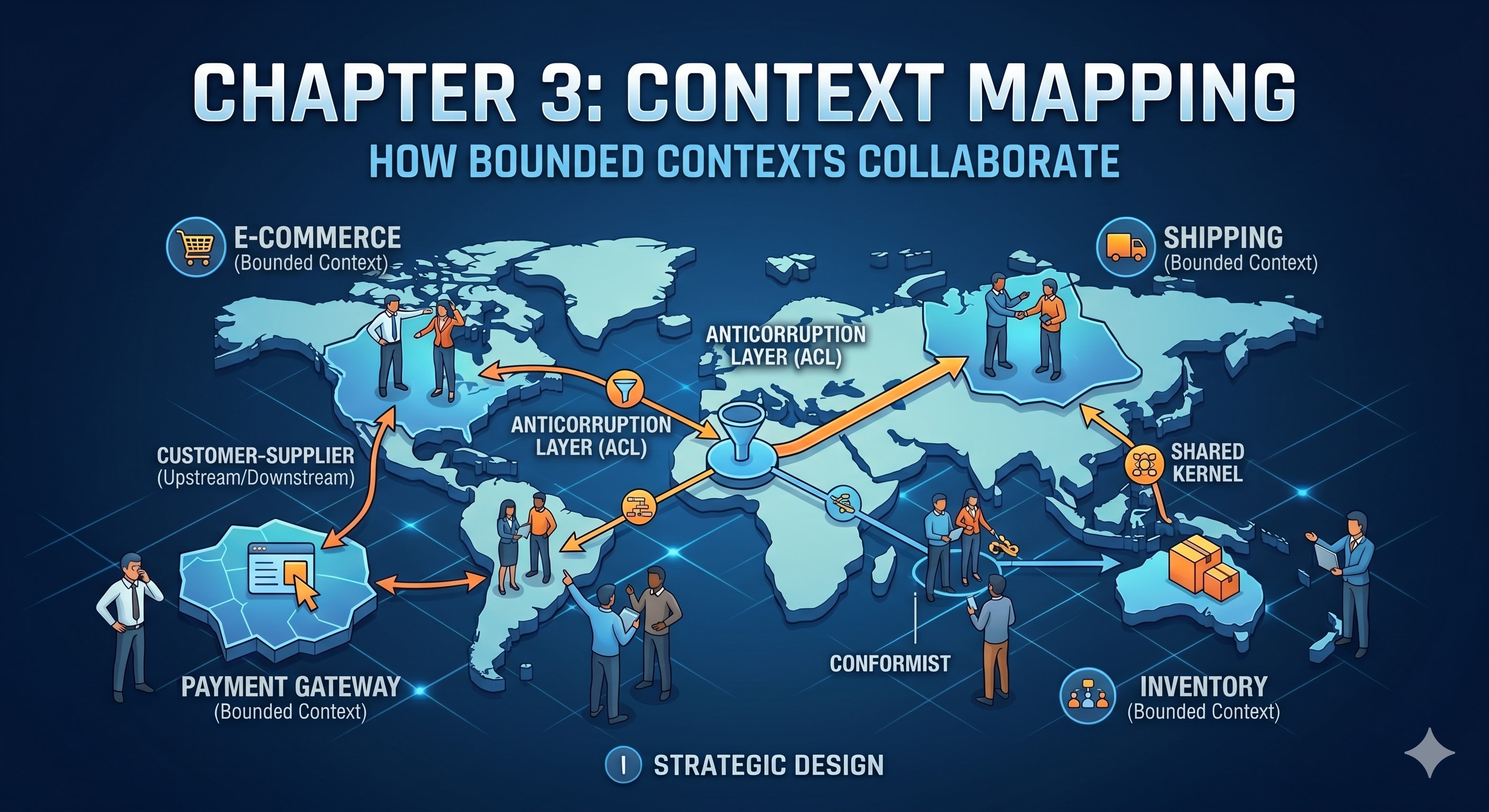
Chapter 3
Context Mapping — How Bounded Contexts Collaborate
I. The Integration Problem
You have identified your Bounded Contexts. Each has its own model, its own Ubiquitous Language, its own team. Now comes the hard part: they have to talk to each other.
An Order Context needs to know if inventory is available. A Billing Context needs order totals from the Order Context. A Notification Context needs to know when an order ships. Every real system involves multiple contexts that must integrate — and how they integrate is one of the most consequential architectural decisions you will make.
Context Mapping is DDD's strategic design tool for documenting, designing, and managing these integration relationships. A Context Map is not just a diagram — it captures the team dynamics, technical coupling, and power relationships between contexts.
II. The Context Map
A Context Map is a visual representation of all Bounded Contexts in a system and the relationships between them. It answers:
- Who depends on whom?
- Who has the power to set terms in an integration?
- How does translation happen at the boundary?
- Which contexts share code and which are fully independent?
┌──────────────┐   Partnership   ┌──────────────────┐
│   Order BC   │────────────────▶│   Inventory BC   │
└──────┬───────┘                 └──────────────────┘
       │
       │ Customer/Supplier
       ▼
┌──────────────┐   Conformist    ┌──────────────────┐
│  Payment BC  │────────────────▶│  Tax Service BC  │
└──────────────┘                 └──────────────────┘
       │
       │ ACL (Anti-Corruption Layer)
       ▼
┌──────────────────────────────────┐
│    External Payment Gateway      │
│    (third-party, no DDD model)   │
└──────────────────────────────────┘
The patterns on the arrows are the eight Context Mapping patterns from Eric Evans and Vaughn Vernon.
III. The Eight Context Mapping Patterns
Patterns fall into three categories based on the power relationship: Upstream (the provider), Downstream (the consumer), or Symmetric (equals).
1. Shared Kernel
Two teams share a common model — a subset of the domain that both contexts use. Changes to the shared kernel require coordination and joint approval.
┌───────────────┐          ┌───────────────┐
│   Context A   │◀──SK──▶ │   Context B   │
└───────────────┘          └───────────────┘
         ↑
    Shared Kernel:
    - Common User entity
    - Shared Money value object
    - Shared domain events
When to use: Two tightly aligned teams with significant model overlap.
Trade-off: High coupling. A change in the kernel requires both teams to update simultaneously. Works only with strong inter-team coordination. Avoid in large organizations.
2. Customer/Supplier
A clear upstream/downstream relationship where the upstream (Supplier) produces the model and the downstream (Customer) consumes it. The Customer can negotiate requirements, but ultimately conforms to the Supplier's timeline.
Upstream (Supplier)        Downstream (Customer)
┌──────────────────┐       ┌──────────────────┐
│  Catalog Service │──────▶│   Order Service  │
│  (sets the terms)│       │  (negotiates but │
│                  │       │   follows Catalog)│
└──────────────────┘       └──────────────────┘
When to use: Two teams with a clear provider/consumer relationship and enough organizational trust for negotiation.
Trade-off: The customer team depends on the supplier's roadmap. Can create delivery bottlenecks.
3. Conformist
Like Customer/Supplier, but the downstream team has no negotiating power. They simply conform to whatever the upstream produces — no pushback, no influence.
Typical scenario: Consuming a third-party API, a legacy system, or a service owned by a powerful team that won't accommodate your needs.
// Conformist: downstream just maps to whatever upstream provides
interface LegacyOrderResponse {
  ord_id: string;
  usr_id: string;
  itm_list: { sku: string; qty: number; prc: number }[];
}

// We have to live with this naming and structure
function mapLegacyOrder(response: LegacyOrderResponse): void {
  // conform to their model
}
When to use: Consuming third-party systems, legacy systems with no modernization budget.
Trade-off: Your model is polluted by the upstream's design decisions. Fine for low-stakes integrations; dangerous for core domain.
4. Anti-Corruption Layer (ACL)
The most important defensive pattern. The downstream team builds a translation layer that converts the upstream's model into its own clean domain model. The upstream model never leaks into the downstream's core.
┌─────────────────────┐     ┌───────────┐     ┌──────────────────┐
│  External Payment   │────▶│    ACL    │────▶│  Payment Context │
│  Gateway (Stripe)   │     │(Translator│     │  (clean model)   │
│  (messy third-party)│     │  Layer)   │     │                  │
└─────────────────────┘     └───────────┘     └──────────────────┘
// ACL: translate Stripe's model into our domain model
class StripePaymentGatewayAdapter implements PaymentGateway {
  async charge(payment: PaymentRequest): Promise<PaymentResult> {
    // Translate our domain model → Stripe's API shape
    const stripeCharge = await stripe.charges.create({
      amount: payment.amount.inCents(),
      currency: payment.currency.code,
      source: payment.card.stripeToken,
    });

    // Translate Stripe's response → our domain model
    return new PaymentResult({
      id: PaymentId.from(stripeCharge.id),
      status: this.mapStripeStatus(stripeCharge.status),
      processedAt: new Date(stripeCharge.created * 1000),
    });
  }

  private mapStripeStatus(stripeStatus: string): PaymentStatus {
    const mapping: Record<string, PaymentStatus> = {
      succeeded: PaymentStatus.SUCCEEDED,
      pending: PaymentStatus.PENDING,
      failed: PaymentStatus.FAILED,
    };
    return mapping[stripeStatus] ?? PaymentStatus.UNKNOWN;
  }
}
When to use: Any time you integrate with an external system, legacy code, or any upstream you don't control. This should be your default for external integrations.
Trade-off: Additional layer to build and maintain. Worth it almost always — the alternative is letting a third-party API's design decisions leak into your core domain.
5. Open Host Service (OHS)
The upstream context provides a well-defined, stable protocol (API) for others to integrate with. Instead of each consumer getting a custom integration, the upstream publishes a general-purpose service.
        ┌──────────────────────┐
        │   Catalog Service    │
        │                      │
        │  Open Host Service:  │
        │  REST API / GraphQL  │
        │  (stable, versioned) │
        └──────────────────────┘
           ↗        ↑        ↖
    Order BC    Mobile App    Search BC
    (consumer)  (consumer)    (consumer)
When to use: One context serves many consumers. Rather than bespoke integrations for each, publish a stable API.
Trade-off: The API becomes a public contract. Changes require careful versioning and backwards compatibility.
6. Published Language
A shared, well-documented language (typically a schema — JSON Schema, Avro, Protobuf, XML) that multiple contexts use to communicate. Often used alongside OHS.
Example: An event schema for OrderPlaced:
{
  "$schema": "http://json-schema.org/draft-07/schema",
  "title": "OrderPlaced",
  "type": "object",
  "properties": {
    "orderId": { "type": "string", "format": "uuid" },
    "customerId": { "type": "string", "format": "uuid" },
    "placedAt": { "type": "string", "format": "date-time" },
    "lineItems": {
      "type": "array",
      "items": {
        "type": "object",
        "properties": {
          "skuCode": { "type": "string" },
          "quantity": { "type": "integer", "minimum": 1 },
          "unitPrice": { "type": "number" }
        }
      }
    }
  }
}
All consuming contexts agree to this schema. Changes are versioned.
When to use: Event-driven architectures, message-based integration, public APIs.
7. Separate Ways
Sometimes the right answer is: don't integrate. Two contexts duplicate some functionality rather than paying the integration cost.
Example: Both the Order context and the Reporting context need to calculate tax amounts. Instead of building a shared Tax service, each implements its own simple tax calculation. They diverge — and that's fine.
When to use: The cost of integration outweighs the cost of duplication. The functionality is genuinely simple or independent.
Trade-off: Duplication. Risk of divergence over time. Only valid when integration complexity is high and the duplicated logic is simple.
8. Partnership
Two teams coordinate as equals, evolving their interfaces together in a tightly coupled way. Changes in one context are coordinated with the other simultaneously.
When to use: Two teams with strong alignment and frequent joint releases.
Trade-off: High coordination overhead. Rarely sustainable beyond two tightly aligned teams.
IV. Upstream vs. Downstream Summary
| Pattern | Relationship | Who Sets Terms |
|---|---|---|
| Shared Kernel | Symmetric | Joint agreement |
| Partnership | Symmetric | Joint agreement |
| Customer/Supplier | Upstream/Downstream | Supplier (negotiated) |
| Conformist | Upstream/Downstream | Upstream (no negotiation) |
| Open Host Service | Upstream → Many | Upstream (via stable API) |
| Published Language | Upstream → Many | Upstream (via schema) |
| Anti-Corruption Layer | Protection | Downstream protects itself |
| Separate Ways | Independent | Neither |
V. Choosing the Right Pattern
Is the upstream third-party or legacy?
  → YES: Anti-Corruption Layer (always)
  → NO: ↓

Does the upstream serve many consumers?
  → YES: Open Host Service + Published Language
  → NO: ↓

Do both teams have equal power and alignment?
  → YES: Partnership or Shared Kernel
  → NO: ↓

Can the downstream negotiate requirements?
  → YES: Customer/Supplier
  → NO: Conformist

Is integration cost higher than duplication cost?
  → YES: Separate Ways
VI. Context Maps Are Living Documents
A Context Map reflects the current reality — not an ideal future state. It captures team dynamics, organizational power, technical debt, and integration patterns as they exist today.
Revisit it:
- When teams change ownership of services
- When new contexts are introduced
- When integration patterns become bottlenecks
- As part of architectural reviews
The map is not a goal. It is a diagnostic tool that makes integration complexity visible so it can be managed.
VII. Summary
| Pattern | Core Idea |
|---|---|
| Shared Kernel | Two contexts share a common model subset |
| Customer/Supplier | Upstream sets terms; downstream negotiates |
| Conformist | Downstream conforms with no negotiation |
| Anti-Corruption Layer | Downstream translates upstream → own model |
| Open Host Service | Upstream publishes a stable API for all consumers |
| Published Language | Shared documented schema for integration |
| Separate Ways | No integration; duplicate instead |
| Partnership | Two equals co-evolve their interfaces |
Further Reading
- Strategic DDD with Context Mapping — InfoQ
- Context Mapping Patterns — Open Group Standard
- Context Mapper Tool — DSL for modeling context maps visually
Next: Chapter 4 — Tactical Building Blocks: how to model Entities, Value Objects, and Aggregates inside a Bounded Context.