Domain-Driven Design: Building Software That Speaks Business
A 6-chapter journey from DDD philosophy through strategic design, tactical building blocks, and real-world architecture — the definitive guide to modeling complex domains.
6 Chapters
- 01The Philosophy of DDD — Why Complexity Kills and How Domain Modeling Fights Back
- 02Ubiquitous Language & Bounded Contexts — One Language, Many Worlds
- 03Context Mapping — How Bounded Contexts Collaborate
- 04Tactical Building Blocks — Entities, Value Objects, and Aggregates
- 05Domain Services, Repositories, and Domain Events
- 06DDD in Practice — Hexagonal Architecture, Clean Architecture & CQRS
Overview
Most software becomes hard to change not because of bad frameworks or wrong databases — but because the code no longer reflects the business it was built to serve. Domain-Driven Design (DDD) is the answer to that problem.
Introduced by Eric Evans in his landmark 2003 book "Domain-Driven Design: Tackling Complexity in the Heart of Software", DDD is both a philosophy and a toolkit for building software whose structure mirrors the real-world domain it models. The result: code that business experts can understand, engineers can reason about, and teams can evolve without fear.
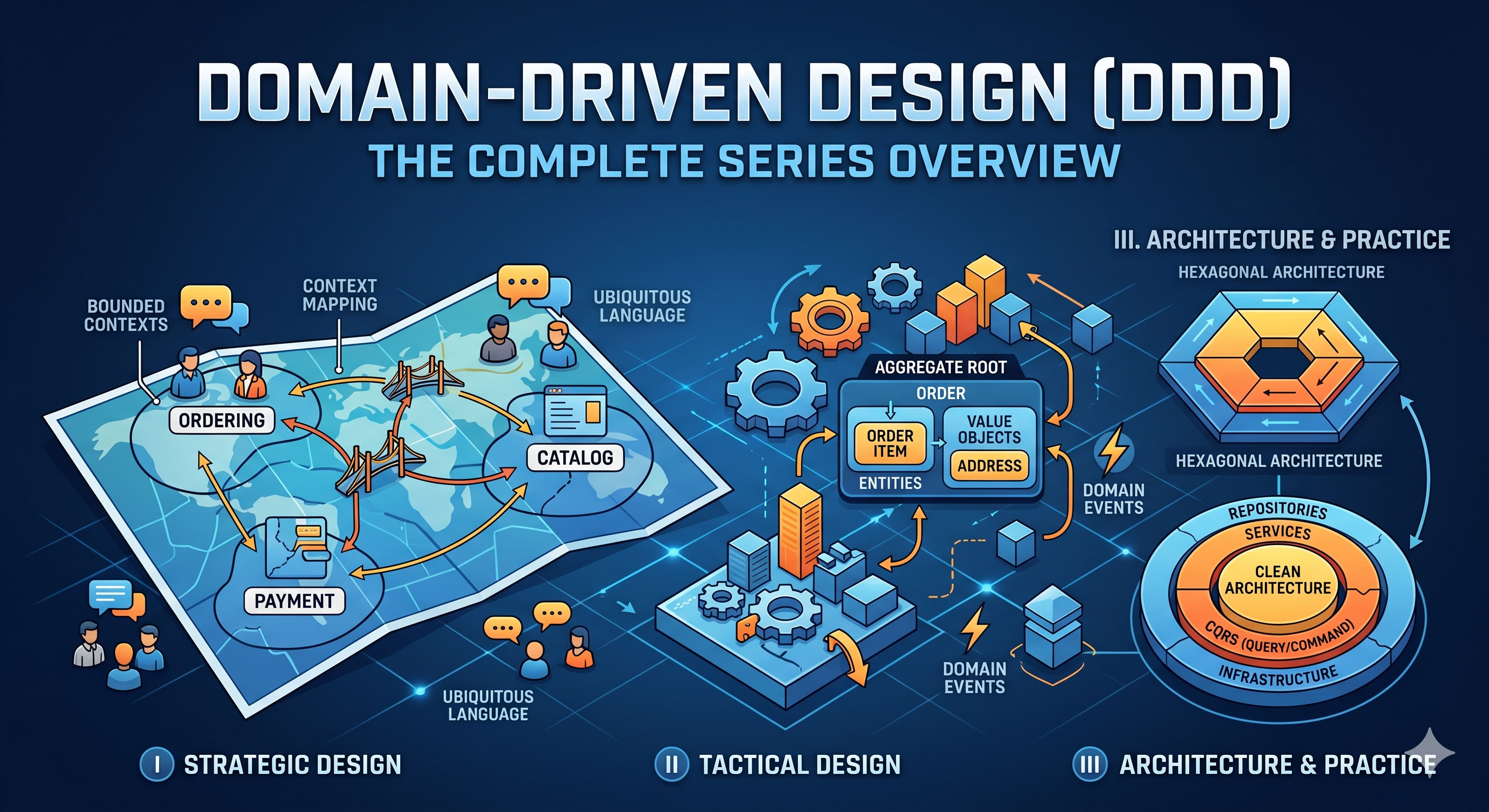
Domain-Driven Design: Building Software That Speaks Business is a 6-chapter series taking you from first principles to production-ready architecture patterns.
Series Structure
Part I — Strategic Design
| # | Chapter |
|---|---|
| 1 | The Philosophy of DDD — Why Complexity Kills and How Domain Modeling Fights Back |
| 2 | Ubiquitous Language & Bounded Contexts — One Language, Many Worlds |
| 3 | Context Mapping — How Bounded Contexts Collaborate |
Part II — Tactical Design
| # | Chapter |
|---|---|
| 4 | Tactical Building Blocks — Entities, Value Objects, and Aggregates |
| 5 | Domain Services, Repositories, and Domain Events |
Part III — Architecture
| # | Chapter |
|---|---|
| 6 | DDD in Practice — Hexagonal Architecture, Clean Architecture & CQRS |
Who This Is For
Backend engineers, software architects, and senior developers working on complex business domains — especially those building or migrating to microservices architectures, where getting the boundaries right makes everything else easier.
Key References
- Domain-Driven Design — Eric Evans (the "Blue Book")
- Implementing Domain-Driven Design — Vaughn Vernon (the "Red Book")
- Learning Domain-Driven Design — Vlad Khononov
- Domain-Driven Design Distilled — Vaughn Vernon (best starting point)
Start with Chapter 1 — it reframes how you think about software complexity before we dive into the patterns.