Chapter 2
AI Fluency: Moving Beyond Literacy to Strategic Mastery
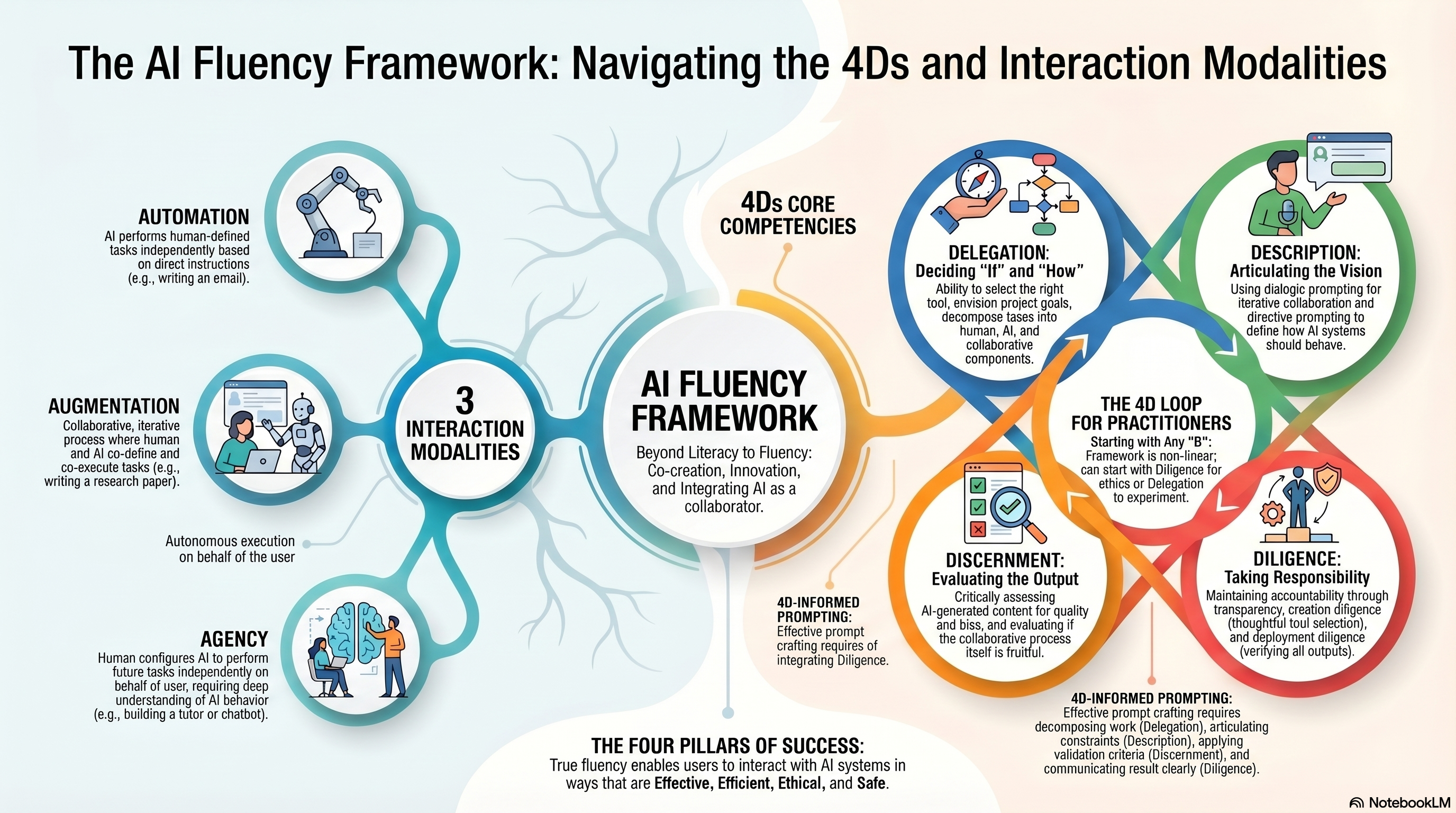
Introduction: Why "Knowing" AI is Your New Technical Debt
In the current tech landscape, AI Literacy—the basic ability to use a chatbot or generate an image—has become a commodity. For a Senior Product Builder, relying solely on literacy is a form of technical debt. It leads to mediocre outputs, "hallucination" risks, and missed opportunities for true innovation.
To lead in the age of intelligence, we must transition to AI Fluency. This is the ability to orchestrate AI systems with the same precision and ethical rigor that we apply to distributed systems or product roadmaps. Based on research from Anthropic and leading academic institutions, let’s explore the framework that turns AI from a tool into a strategic partner.
1. The Hierarchy of Interaction: From Automation to Agency
Most developers get stuck at the first level. To build superior products, you must understand where your current workflow sits within these three modalities:
A. Automation (The Task-Runner)
This is the "Low-Level" interaction. You give a command; the AI provides an output.
- Examples: Generating boilerplate code, writing unit tests, or summarizing a meeting transcript.
- The Risk: Over-reliance here leads to "Lazy Engineering," where the developer stops questioning the underlying logic.
B. Augmentation (The Thinking Partner)
This is where the magic happens for Product Builders. It’s an iterative, back-and-forth dialogue.
- Examples: Brainstorming edge cases for a new feature, refactoring a complex architecture for better scalability, or debating the pros/cons of a tech stack.
- The Goal: The AI doesn't replace your brain; it expands your cognitive bandwidth.
C. Agency (The Autonomous Representative)
The highest level of fluency. You don't just prompt the AI; you design its behavior and constraints so it can act independently.
- Examples: Setting up an AI agent to monitor production logs and suggest fixes, or creating a sub-agent to perform security audits on every PR.
2. Mastering the "4Ds" — The Senior Product Builder’s Playbook
To navigate the modalities above, you need to master four core competencies. These are the "soft skills" that determine your "hard results."
🛡️ Delegation: The Art of Strategic Selection
Not every problem should be solved by AI.
- Vision: A Senior Builder knows that high-stakes architectural decisions require human intuition and historical context.
- Selection: You must choose the right model for the job. You wouldn't use a lightweight model for a complex refactor, nor would you waste a high-reasoning model (like Claude 3.5 Sonnet) on simple string formatting.
✍️ Description: More Than Just Prompting
Forget "Prompt Engineering"; think "System Instruction." Fluency means being able to translate a vague business requirement into a structured technical specification that an AI can execute flawlessly. It involves defining:
- Constraints: What should the AI never do?
- Context: What is the legacy code it needs to respect?
- Success Metrics: How will the AI know it has done a good job?
🔍 Discernment: The Critical Filter
This is the most under-developed skill in junior engineers. AI outputs are statistically probable, not necessarily correct.
- Audit Everything: You must develop the "sniff test" for AI-generated code. Does it follow SOLID principles? Is it introducing hidden performance bottlenecks?
- Bias Awareness: Recognizing when an AI is leaning toward a specific (perhaps outdated) pattern and steering it back toward modern standards.
⚖️ Diligence: Ultimate Accountability
As a Product Builder, you are the bottleneck of quality. If an AI-generated bug reaches production, it is your bug, not the AI's. Diligence means:
- Fact-Checking: Verifying every library, API version, and logic flow.
- Ethical Oversight: Ensuring the data used by your AI features respects user privacy and legal compliance.
3. The Socio-Technical Shift: A Conclusion
The future belongs to those who view generative AI as a socio-technical system. It is a blend of human creativity, ethical responsibility, and machine efficiency.
By moving from Literacy to Fluency, you stop being a "user" of technology and start being an architect of intelligence. You don't just build apps; you build intelligent systems that solve real-world problems with unprecedented speed and safety.